CX/UX Discovery · Liber · Insight leadership and research operations
Embedded Customer Insight into Early Product Decision-Making
I led the development and implementation of a shared CX/UX insight operating model for early discovery at Liber. The approach enables teams to involve customers and users continuously, focus research on the most critical uncertainties, and use insight from needs exploration and concept testing to inform product decisions. I piloted and refined the model across five live projects and built the supporting methods, tools, and guidance for the end-to-end research process.
- My role
- CX/UX Discovery Lead
- Year
- 2026, ongoing
- Industry
- Learning materials
- Company
- Liber AB
- Scope
- 4 months
The short version
The problem
Customer and user insights were collected all over the organisation, but there was no shared way to document, share and use them. Decisions risked resting on assumptions.
What I did
I mapped the current state, developed the operating model with key people across the organisation, and piloted and refined it hands-on in five live projects. Their interviews gave about 120 observations and 25 insights.
What I delivered
A decision-driven way of working, method support for the whole research flow with 18 resources, and a customer panel under construction.
What I led
An insight operating model
One shared flow from question to decision, with defined decision points and clear responsibilities between CX and the project teams.
Five teams, coached hands-on
I worked alongside five live projects through every step: choosing, planning, carrying out and following up their research.
Research operations
A resource bank with 18 guides, templates, workshops and AI supports, and a customer panel for faster recruitment that is now being built up.
AI in the research process
Ten ready-made prompts, including one that takes a team from transcripts to observations, insights and remaining uncertainties.
The problem
Customer and user insights were collected in different parts of the organisation, but there was no shared way to document, share and use that knowledge in product development. That had three consequences.
Existing insights were overlooked
Knowledge that already existed risked not being used.
Studies were repeated
Similar studies were carried out several times.
Customers came in too late
Customers and users were involved late in the work.
Decisions therefore risked being based on assumptions, and concepts were sometimes developed long before their relevance and value had been tested.
Goal and challenge
The goal was to make CX/UX research easier to carry out and more clearly tied to decisions. That is why the work covered three things: the way of working, the method support, and access to the right target groups.
The effects we want to achieve
Learning materials that meet the needs in teaching
By understanding how teaching actually happens and testing solutions with the target group.
Measured bySales and NPS
Better-founded decisions and fewer late redos
Through customer insights that reduce the most important uncertainties, and concepts that are tested early.
Measured byThe number of late redos in production
Faster work and less duplication
Through clear responsibilities, easier access to customers, a focus on the right questions, and customer knowledge that is saved and reused.
Measured byTime from start to recommendation, and how often earlier insights are reused
The challenge was to create one way of working that several functions, projects and product areas could use, each with its own needs and habits. It had to be clear enough to give structure and comparable material for decisions, and flexible enough to work in very different projects.
Continuous, not occasional
It also had to create the practical conditions for involving customers and users continuously, not only in occasional research efforts.
How I worked
My role
I led the work of mapping the current state, gathering perspectives from different parts of the organisation and identifying what stood in the way of a more continuous insight practice.
Through interviews and workshops I developed the process together with key people from the business. I structured the way of working, defined the decision points, and created support for how teams gather existing knowledge, identify assumptions and plan the right kind of customer and user involvement.
The team
The work was cross-functional, together with CX, process owners, product management, publishers and project managers. Their different perspectives were needed for the way of working to function both strategically and in day-to-day product development.
Piloted and refined in five live projects
The way of working was shaped in real projects. In May I went into five projects that were already under way and worked closely with the people leading them. I supported them hands-on in choosing, planning, carrying out and following up their CX/UX research, and used what we learned to build the method support.
- 1SwedishPrimary school, years 1–4
- 2SwedishLower secondary school, years 7–9
- 3New digital platform for mathematicsLower secondary school
- 4MathematicsUpper secondary school
- 5SFISwedish for immigrants
What the interviews gave
- about 120observations
- about 25insights
- 3–5findings per main question
- 6–8opportunity areas per area
I created an AI support, in the form of a prompt, to raise the quality of the synthesis work and make it faster: from transcripts to observations, and on to findings, core insights, opportunity areas and remaining uncertainties. The support was used in all the initiatives and can also be used on material collected earlier, to build one shared base of customer knowledge. It gives a clearer basis for judging how insights affect choices of direction, recommendations and decisions ahead.
Why pilots
Working through every step together with the teams showed what they needed in practice. That is how the support became tailored to Liber’s organisation, and not a generic method.
What the pilots taught us
Three lessons came out of the five projects, about how CX/UX research is chosen, carried out and used.
1
Choosing the right CX/UX research
What we saw
It was not clear which questions mattered most, and the method was sometimes chosen because time was short.
Going forward
Choose the method from the most important uncertainties we need to reduce: what we do not already know.
2
Carrying it out
What we saw
It was unclear who writes the questions for the target group, and recruitment was not coordinated.
Going forward
Decide who writes the interview questions, and coordinate recruitment centrally through the customer panel.
3
From observations to decision material
What we saw
The interviews were summarised, but not synthesised into material for a decision.
Going forward
Synthesise, do not only summarise. Go from insights to decision together.
A concrete example: start with what we already know
In one of the projects, an earlier needs analysis had already mapped the central needs of the target group. The new CX/UX research started before that material had been made visible. When the two were put side by side, several central needs turned out to be known already. What was new was a deeper understanding of when and how digital creates value.
- Start with what we already knowCX/UX research should not start from a blank page. It starts from what we already know and what is still uncertain. The uncertainties become research questions to explore, so that what we learn can then influence decisions.
- Narrow it to what blocks the next decisionReduce the uncertainties that really need to be better understood. Do not automatically explore again what is already known well enough.
- Choose the right next stepLet what we know and do not know decide what is done next: a needs analysis, a validation of needs, or a concept test.
The new way of working
The proposal is simple to say: let the decisions we need to make, and the uncertainties that remain, steer the CX/UX research. For that to work, three shifts are needed.
Fromactivity-driven
Todecision-driven CX/UX research
Start from the decision to be made and the uncertainties that need to be reduced.
Fromproject-specific
Toreusable customer knowledge
Make earlier and new knowledge available, so the next project can start with what we already know.
Fromad hoc
Toshared conditions
Shared method support, clear responsibilities and easier access to the right target groups.
Four choices behind it
Start with what we already know
Gather what the organisation already knows before new research is planned.
Separate knowledge from assumptions
Make visible what is supported by evidence, what is uncertain and which knowledge gaps exist.
Tie the involvement to a decision
Start from the choice or decision the study should contribute to.
Explore before solution, test before investment
Understand needs and test concepts before larger investments are made.
The flow, from initiation to production

- What we know and what we need to exploreGather relevant existing knowledge, identify the most important uncertainties and formulate the research questions that need answering to inform the choices and decisions of the project.
- Choose the method and plan the explorationChoose the CX/UX research method from the most important uncertainties and decisions, and make a plan. This happens before the planning decision.
- Explore needs and decide on a directionUnderstand the target group’s teaching situation, needs, frictions and underlying challenges. Qualitative when needs and causes have to be understood, quantitative when it matters how common they are. When the needs are known, the team generates ideas and concepts to test.
- Test ideas and conceptsTest them with customers and users to see what creates value, what works and what needs to change.
- Compile for the decisionPut together what has been learned and how it affects the decision. Show the remaining uncertainties and weigh insights, risks and other perspectives into a clear recommendation: go ahead, explore more, change direction or pause.
If uncertainties remain, the team goes back to explore more or test more before the production decision.
Two situations where it is used
Situation 01
When we explore a need
The team gathers existing knowledge, identifies the critical questions and involves relevant teachers or pupils before a solution direction is formulated. The result is used to prioritise which problem is most important to solve.
Situation 02
When we test a concept
The team formulates which assumptions need to be validated and lets customers or users react to alternative concepts. The results are used to choose a direction, change the solution or refrain from an investment.
Method support for every step
A way of working only gets used if people have something to work with. I delivered method support for the whole CX/UX research flow as a resource bank: AI support, guides and templates for every step from question to insight. It is managed, kept visible and developed further by CX, and anyone can use it.
The research flow, step by step
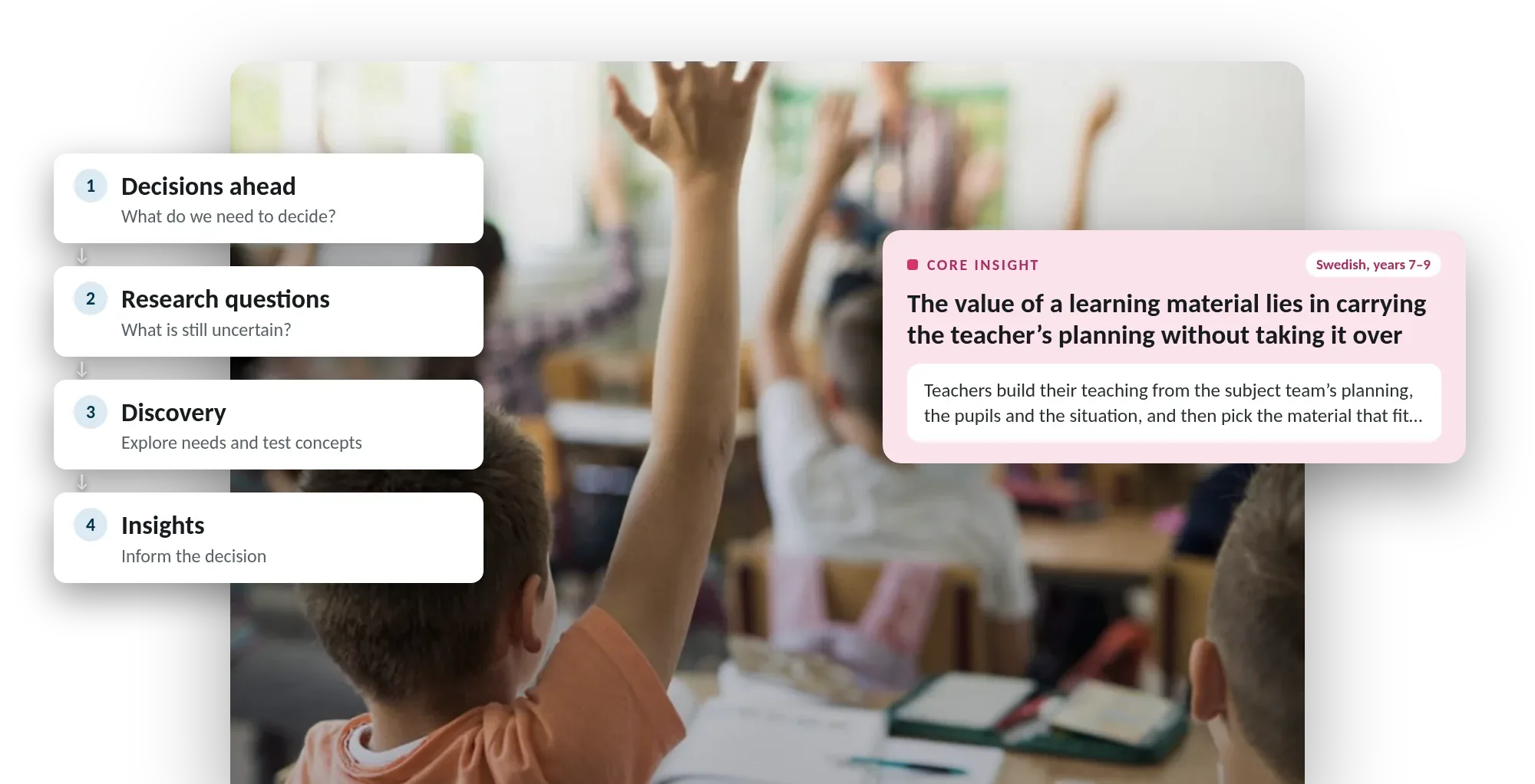
From the decisions ahead to insight: the steps a team goes through in every CX/UX research effort, each one with its own method support.
- Gather what is already known and what is still uncertain for decisions ahead
- Formulate and prioritise research questions for decisions ahead
- Choose the CX/UX discovery method from the questions and the decisions ahead
- Set target group criteria and recruit participants
- Prepare the guide, questions and material to react to
- Conduct the research and collect data
- SynthesisTranscripts → Observations → Findings → Core insights → Opportunity areas → Remaining uncertainties

The resources are sorted under four stages, from planning to using the insights.
- Plan ahead of project planningMake sure that what is going to be explored is clear and tied to a decision, and choose the methods that best help reduce uncertainty. 5 resources.
- Carry out CX/UX researchFill in the CX/UX research brief and draft the interview, test or survey questions. 11 resources.
- Analyse and synthesiseWork through the material to bring out findings, insights and opportunities. 1 resource.
- Share and use insightsGo from insights to a recommendation ahead of a decision. 1 resource.
Four kinds of support, 18 resources
10 resources
AI support
Ready-made prompts that work as a knowledgeable sounding board and take a team faster from question to insight.
6 resources
Guides
Show how each step is done.
1 resource
Templates
Filled in together by the team.
1 resource
Workshops
Tips on how to work together.
Faster access to the right target group
The third part is a customer panel. It is under construction: to be a real support in the projects it needs more participants per target group and a shorter time to the right participant.
Faster recruitment
For interviews, surveys and concept tests.
A better match in the target group
Through clear criteria for who we need to talk to.
Less duplicated work
Through one shared way in to customers.
A better customer relationship
Through coordinated contact, and clarity about how often customers are involved.
The project team defines which target group and which criteria are needed. CX and the customer panel support with selection, contact and coordination.
The effect
Shorten the time from “we need to talk to the target group” to completed CX/UX research.
What is done, phase by phase
A resource is only useful if people know when to reach for it. So alongside the resource bank I described what is actually done in each phase of Liber’s development process: the operative activities of CX/UX research, and the guide, template or AI support that goes with each one.
When is new CX/UX research done?
When there is a prioritised uncertainty about customers or users, and more knowledge could change a choice, a solution, the quality of the product or a decision. The questions always come before the method.
Know what to find out before the project starts
- What do we know?
- What is uncertain?
- CX/UX research questions
- Method
- Planned activities
- Planning decision
Work that often happened after the start is moved, as far as possible, to before the decision. That does not mean everything is planned in detail. It means the team starts knowing what is already understood, what is still uncertain, and which decision each question feeds.
Activities
- WorkshopCompile existing customer knowledgeGather and show what is already known, and the known gaps, tied to the decisions the project should give a better basis for.
- GuideAI supportFormulate and prioritise the questionsState what needs to be better understood about the customer or user, and which decision or choice each question should feed.
- AI supportWorkshopGet support with questions and methodGo from existing knowledge and identified uncertainties to clear questions and a first choice of method.
- GuideAI supportRecommend a methodOne method or a combination, based on the kind of knowledge the prioritised questions need.
- Plan the first activitiesMake sure the activities and chosen methods are in the overall activity plan.
- Show it in the decision materialExisting knowledge, prioritised questions and planned activities are visible to the decision forum.
Carry out, synthesise, and use it in the recommendation
- Carry out
- Observations
- Synthesis
- Insights and opportunities
- Remaining uncertainties
- What it means for the choices
- Recommendation
The focus is on carrying out the planned activities, synthesising what is learned and using it as a basis for the project’s choices and recommendation. The plan is reconsidered if new learning shows that an uncertainty remains, a new one has appeared, or another method is needed.
Before an activity starts
- TemplateWrite the CX/UX research briefPurpose, questions, target group, method, who does what and the practical conditions for this activity.
- Plan the activityDecide when it runs and make sure it fits in the overall plan.
- Recruit participants or send the surveyThrough the customer panel, in the agreed way.
- GuideAI supportWrite interview, test or survey questionsTranslate the CX/UX research questions into neutral questions, tasks or measures that suit the method.
- GuidePrepare the trigger materialWhat participants react to or use: a product overview, a concept, a proposed solution or a prototype.
While it runs
- GuideQualitative CX/UX researchInterview, observation, concept test, usability test or another qualitative method.
- Quantitative CX/UX researchA survey or other structured data collection.
When interviews or the survey are done
- GuideAI supportCompile observationsTurn the material into observations that stay close to the evidence and can be traced back.
- Document in the insight portalSave quality-assured observations so the knowledge can be found and reused in later analyses and projects.
- GuideSynthesiseFindings and patterns, main insights, opportunity areas and remaining uncertainties.
Connect it to the decision
- GuideConnect insights to choices and decisionsAssess what the insights mean for the choices at hand and bring them into the overall decision material.
- GuideAssess remaining uncertaintiesWhich can be accepted, which need weighing against other evidence, and which need more exploring before the recommendation is finished.
Reduce what is still uncertain and assure quality before launch
- Production decision
- What do we still need to understand or assure?
- Plan
- Carry out
- Synthesis
- Refine the solution
- Launch
The same principles apply, but the starting point is usually a more concrete product, solution or piece of content. CX/UX research is used to explore new or remaining questions, test the product, content, concept or user flows, look at understanding, usability, relevance and experience, and find improvements before launch.
What is specific to this phase
- GuideChoose the methodBased on the questions or quality-assurance needs that come up during production.
- Time it rightPlan the activity so that what is learned can still affect the ongoing development.
- GuideTurn learnings into product improvementsAssess what the results mean for the solution and turn them into concrete changes or priorities.
Then the same steps as during planning
- TemplateGuideAI supportPrepare, carry out, compile and documentBrief, recruitment, questions and trigger material, then the qualitative or quantitative activity, observations and the insight portal.
Learn from real use
- Launch
- Actual use
- Follow-up
- Evaluation
- Improvements
The aim is to understand how the product actually works for the customer in its real setting, and to create learning for both continued development and future projects. A follow-up can start from feedback in the insight portal, signals from support or sales, usage, product or sales data, problems that only show in real use, or uncertainties left from earlier phases.
What is specific to this phase
- Identify signalsGather and show signals from NPS, the insight portal, support, sales, product data, usage and earlier CX/UX research.
- Assess the need for deeper knowledgeDoes the signal call for more CX/UX research, and what kind of understanding is needed?
- GuideDesign the follow-upChoose the method and set up the follow-up.
- Turn learnings into product improvementsAssess what the results mean for the product and turn them into changes or priorities.
Then the same steps as during planning
- TemplateGuideAI supportPrepare and carry outBrief, planning, recruitment, questions and trigger material, then the qualitative or quantitative activity.
GuideAI supportTemplateWorkshop The tags show which resources in the resource bank support the activity.
Next steps
The next step is to go from pilots to a shared way of working across Liber.
- Start using the way of working in coming projectsLet decisions, existing knowledge and remaining uncertainties steer which CX/UX research is needed.
- Set responsibilities and method support in everyday workCX manages method, quality and support. The project teams own what they need to learn and how the insights are used in decisions.
- Keep building the customer panelIncrease the number of participants in prioritised target groups and shorten the time to the right participant.
- Make customer knowledge reusableCreate a shared structure for saving and finding observations, findings and core insights.